00Before placement
Prepare the environment
Stabilise the house before chicks arrive. Floor and litter temperature, air, water and light must work together so the flock can start feeding immediately.
Watch closelyFloor & litter · air · water · light
 Contact us
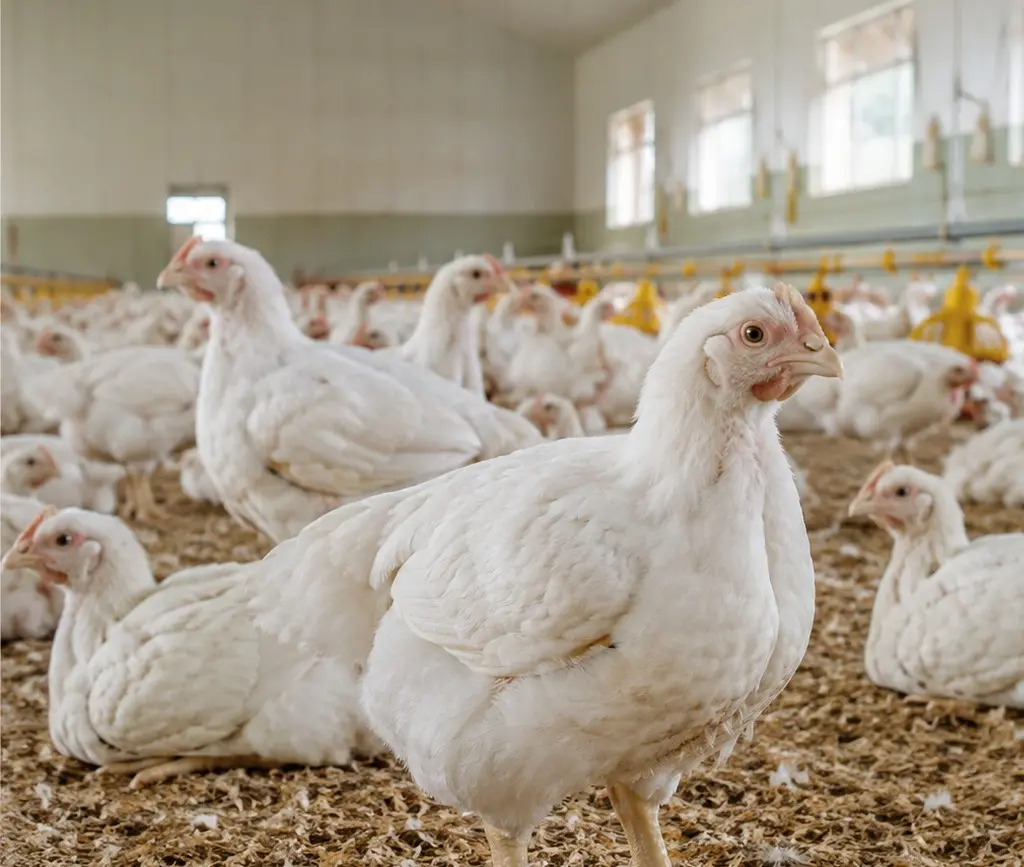
Broiler nutrition
From pre-placement to market weight, broiler performance depends on a prepared environment, rapid access to feed and water, phase-led nutrition and daily control.
Broiler nutrition performs only when the feed programme and the farm environment move together.
Greenagro connects phase-specific nutrition with observed weight, consumption, water, climate, health and the farm's final market target.
Practical management markers from the Greenagro Broiler Handbook. They are reference points; flock response and local conditions determine the decision.
Production stages
Phase changes should reflect age, achieved weight, consumption and the market objective. The calendar informs the programme; the flock confirms it.
Stabilise the house before chicks arrive. Floor and litter temperature, air, water and light must work together so the flock can start feeding immediately.
The first hours establish digestive, immune and organ development. Easy access, rapid crop fill and a consistent crumble help turn placement quality into uniform early growth.
As daily gain accelerates, digestible nutrients, pellet quality and real consumption must remain aligned. Weight and uniformity guide the transition—not age alone.
The programme now balances muscle deposition, feed efficiency and economics while protecting litter condition, mobility and the flock's response to the environment.
For longer cycles, nutrient objectives are adjusted to market weight and carcass goals. Final decisions account for intake, welfare and catching readiness as one connected system.
Four operating pillars
These four areas are managed as one system throughout the cycle.
Preheating, floor conditions, brooding temperature and chick behaviour establish the biological foundation.
Correct feed form, balanced digestible nutrients and uninterrupted clean water protect daily intake.
Ventilation and lighting guide comfort, activity, litter quality and access to feed and water.
Biosecurity, daily observation and consistent records turn early signals into timely decisions.
Nutritional challenges
A performance gap may begin in the feed, but it may also begin with access, water, physical feed quality, air or health. Diagnosis comes first.
Discuss your flockDelayed access or incomplete crop fill reduces the time available for organ, gut and immune development.
Formulation quality depends on current analyses of grains, protein meals, oils and minerals—not book values alone.
Digestible amino acids and energy must be balanced. Excess crude protein adds metabolic and litter pressure without guaranteeing growth.
Excess fines, separation or poor pellet quality can appear to be a nutritional problem because they restrict effective intake.
Water consumption, air quality, temperature and litter condition should be interpreted together every day.
Air and cool, sanitary water come first; feeding time and nutrient concentration then help manage lower intake.
Feeding programme
Greenagro programmes can be designed on a corn or wheat basis. The final approach depends on current raw-material analyses, production conditions and the farm's target.
Designed for fast access, digestive development and a uniform start.
Supports accelerating growth with controlled nutrient density and feed form.
Targets efficient muscle gain, conversion and production economics.
Rebalances the programme for birds kept beyond day 40 and the final market objective.
Exact recipes, nutrient specifications and inclusion decisions are developed for the selected ingredients, manufacturing process and production objective.
Performance dashboard
The most useful dashboard is consistent, current and connected to action. Daily trends reveal more than a single isolated result.
Track sample weight and flock spread against the same reference conditions.
Record daily and cumulative feed, then connect change with weight gain.
Read water use, mortality, behaviour and droppings as an early-warning group.
Review temperature, humidity, air quality and litter condition together.
Content adapted from the Greenagro Practical Broiler Handbook, informed by Aviagen Ross broiler management, nutrition and performance references. This page provides general information and does not replace ingredient analyses, a farm-specific formulation, veterinary guidance or applicable local requirements.
Greenagro expertise