Protect the mineral margin.
Forage supply, body condition and production stage lead the plan. Sheep sensitivity to excess copper makes species-appropriate mineral selection and cross-feeding control essential.
 Contact us
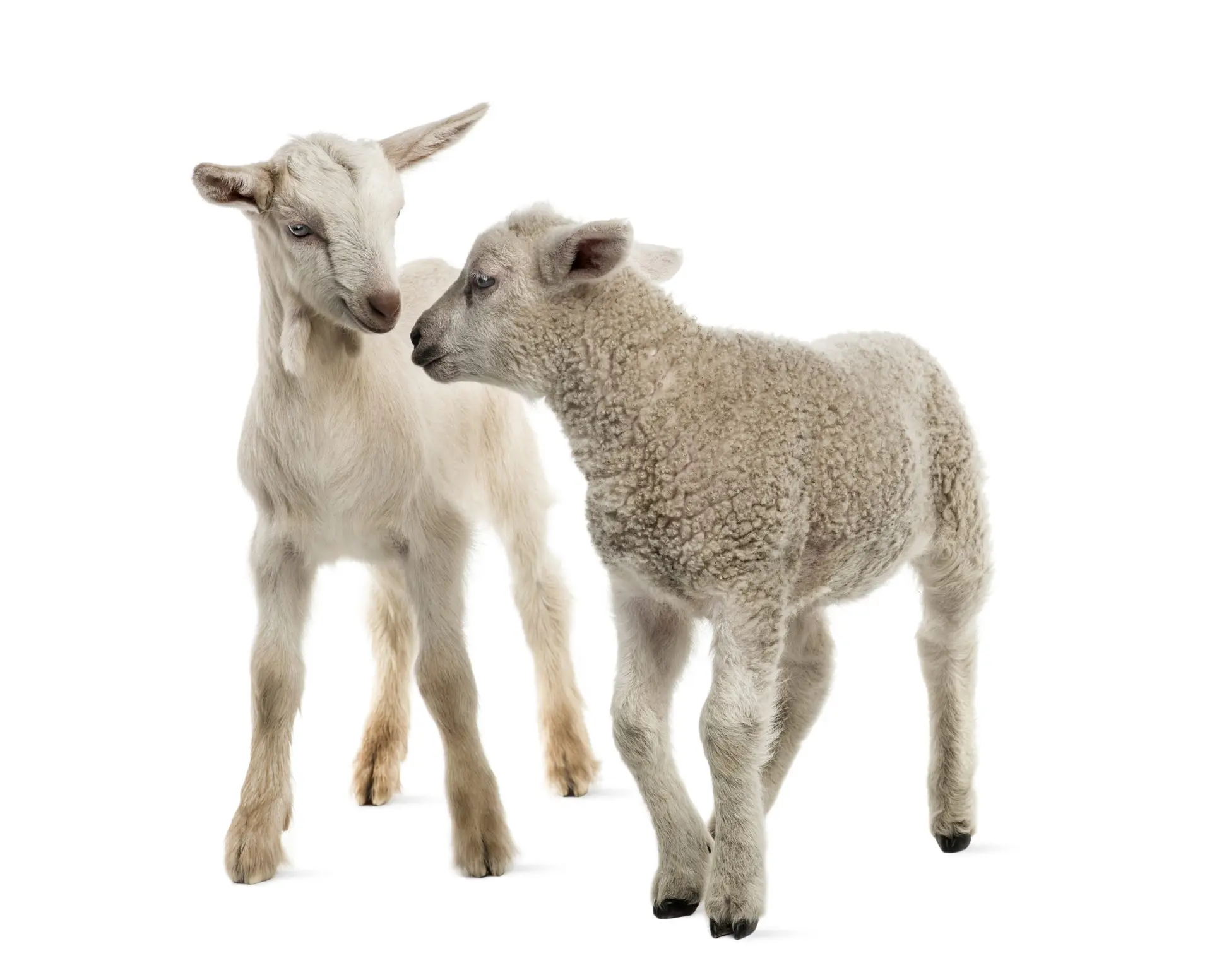
Small-ruminant nutrition
Sheep and goats share ruminant biology, but not every feeding decision. Greenagro connects species, forage, season, body condition and production stage before defining the programme.
A mineral or concentrate recommendation only makes sense after understanding what the flock or herd already consumes.
The same forage can support maintenance yet fall short during late pregnancy, lactation or rapid growth. The response is stage-specific, species-aware and measurable.
Operational focus points rather than fixed performance guarantees. Breed, health, forage, housing, climate and management determine the farm-specific targets.
One category · two species
Feeding behaviour, production purpose and trace-mineral tolerance must be confirmed before sheep and goats share a programme.
Forage supply, body condition and production stage lead the plan. Sheep sensitivity to excess copper makes species-appropriate mineral selection and cross-feeding control essential.
Goats often select browse and plant parts differently from sheep. Their diet and trace-mineral programme should reflect the actual feed base, stage and production objective.
Never assume that cattle, sheep and goat mineral products are interchangeable. Confirm the intended species, complete label and total diet before use.
Adult production cycle
The nutritional year is continuous: maintenance prepares breeding, pregnancy prepares birth, and lactation affects both the young and the dam's recovery.
After weaning or milking, the objective is to recover appropriate body condition without unnecessary concentrate use. Forage supply and the next breeding date define the pace.
Condition, liveweight trend and forage quality are reviewed before any short-term nutritional support. Thin and over-conditioned animals should not be managed as one group.
Stable forage intake, balanced minerals and sensible condition control support the dam while fetal demand remains lower than in the final phase.
Fetal growth accelerates while physical intake capacity may tighten. Litter size, forage analysis and condition determine how carefully energy and protein density must rise.
Milk output, number of young, forage intake and body-reserve change shape the lactation programme. Clean water and reliable access are part of the ration.
Young-stock pathway
Lambs and kids need a protected start, progressive feed discovery and a deliberate weaning transition suited to the farm's system.
Colostrum, warmth, bonding and trained observation establish the first line of protection after lambing or kidding.
Milk supply remains central while fresh, palatable feed and suitable forage encourage rumen development.
The transition follows real intake and development. Abrupt changes in feed, group or environment are kept to a minimum.
Growth targets, frame development, future breeding role and forage quality guide the programme—not maximum gain alone.
Nutritional challenges
A supplement cannot correct poor access, unsuitable forage allocation, unmanaged disease or the wrong mineral product.
Discuss your flock or herdPasture, browse, hay and silage change with field, maturity, weather and storage. Visual appearance alone does not describe nutrient supply.
Late pregnancy, early lactation and rapid growth can create demand that low-quality forage cannot cover within normal intake capacity.
Sheep are especially sensitive to excess copper, while goats may require a different trace-mineral approach. Species-specific products and labels matter.
Sudden changes in forage, concentrate amount or feed form can disrupt intake and rumen stability. Adaptation must be planned.
Dominance, trough space, pasture availability and group variation determine whether every animal can consume the intended programme.
Parasite pressure, feet, teeth and disease can suppress intake and performance. Nutrition data must be read alongside the health plan.
Forage-first workflow
The purpose is not to supplement everything. It is to identify the gaps that matter for this group, in this season.
Map pasture, browse, conserved forage and purchased feeds by quantity and season.
Use representative samples to understand dry matter, energy, protein, fibre and mineral context.
Allocate forage by species, production stage, condition and realistic intake.
Add only the protein, energy, minerals or vitamins the group and base diet require.
Follow consumption, condition, growth, milk and health; adjust when the forage or animal changes.
Feeding programme
The final programme depends on species, liveweight, physiological stage, expected output, measured intake, forage analysis, water, health and management.
Species-appropriate vitamin and mineral support developed around forage, stage and copper safety.
Programmes that consider browsing behaviour, production level, physiological stage and species-specific mineral needs.
Support for pre-weaning feed discovery, rumen development, weaning and controlled growth.
Stage-led support for breeding preparation, pregnancy, birth, lactation and recovery.
Exact recipes, mineral specifications and inclusion decisions are developed for the intended species, analysed feeds, farm system, health status and production objective.
Farm dashboard
Simple, consistent records reveal whether the programme is working and when a change in season, forage or production stage requires a new decision.
Inventory · analysis · refusals · seasonal change
Body condition · liveweight trend · intake · grouping
Dam readiness · births · vitality · losses
Growth · feed discovery · weaning · uniformity
Milk · growth · reproduction · days to target
Correct product · consumption · storage · access
General stage structure informed by university small-ruminant nutrition guidance and veterinary references on forage, life-stage demand and mineral safety. This page does not replace forage analyses, farm-specific formulation, veterinary direction, product documentation or local requirements.
Greenagro expertise